

The Black Farm Tour; Modern Black Permaculture
📰 This story can be found in the print issue of The Richmond Seen.
“My family never had land. My grandma did, in Spotsylvania County, but it was sold to the city. I’m starting from scratch.”
by Chelsea Jackson
We began at Lumpkin’s Jail — ground zero.
“This is Richmond, Virginia, right?” said Duron Chavis, founder of Happily Natural Day. “First colony. Capital state of the first state. 1619 — well, we know Black people were brought here as early as 1526. This is the start of the American experiment here in Virginia. So why not start the Black Farm Tour at the African Burial Ground, the devil’s half acre, Lumpkin’s Jail? This is ground zero for the African experience in the United States.”
On Friday’s Black Farm Tour, Duron Chavis led a moving classroom that connected food, history, and liberation.
From the shadows of the jail, buses headed south toward Petersburg, where we met farmers Obar Moyo and Natasha Crawford— a veteran from Georgia who farms as a form of mental health therapy and the founder and owner of Healing Hope Urban Gardens.
As we walked through rows of okra, melons, and purple sweet potatoes, the work felt both tender and radical. Every seed in the soil told a story of resilience.
“I’m from Georgia originally,” Crawford said. “My great-grandmother grew up on a farm. Even after she left, living with my grandmother, she kept her daughter in the garden. I remember being out there as a little kid.”
“We didn’t have access to fresh fruits and vegetables growing up. But we got them from my great-grandmother’s garden. Everything I do, I do in honor of her. She lived to be 103.”
Healing the land, for Natasha, is about healing lineage.
“I love being in Petersburg because I see my family here. And I see that it’s possible — possible for us to have access to fresh fruits, veggies, education around that, and how to prepare meals outside of just frying everything. I mean, don’t get me wrong, I love a good fried chicken — but I like to show other ways too.”
Her training, discipline, and adaptability come from her military background — tools she now uses to navigate farm life.
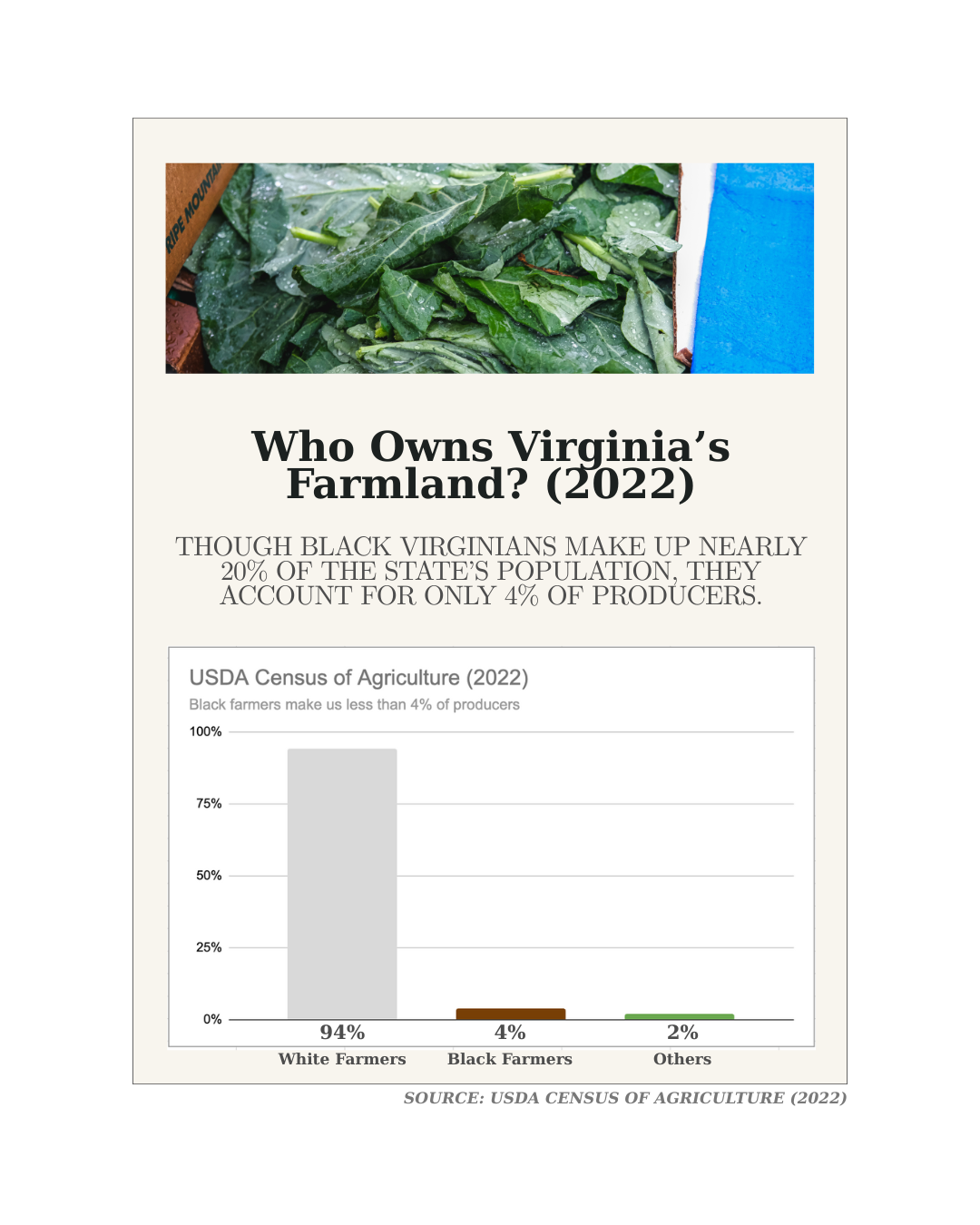
Black farmers once owned 14% of all U.S. farmland. Today: less than 2%.
Land was taken. Legacies were interrupted.
And still — Black growers are planting futures anyway.
“You gotta be able to adapt. I feel really blessed — I’ve had a great support system. A lot of stuff, I taught myself. I did the Urban Ag course at VSU. But I also go straight to folks like Duron. I’m not afraid to ask, because I don’t know everything. I’m constantly learning out here.”
Before leaving, we all indulged in a quinoa dish prepared by Vegan T.H.O.T.S.and a watermelon juice prepared by Natroganix Flow Space.
A trail of thank-yous led the tour back onto the buses, this time bound for Mechanicsville. We arrived to bowls of Mediterranean stew prepared by the 1821 Catering Company.
We gathered again, as we listened to Mark Davis — founder of Real Root Food Systems — tell the story of how he turned an unused patch of church land into a thriving urban farm.
“I approached the church — a few ladies over there and a friend who’s no longer with us — and said, ‘Hey, would you consider creating a contract directly with us?’ They were open to it. They were paying someone to mow the land. We proposed a solution: let us grow food for your food pantry instead.”
It wasn’t a lease, Mark clarified, but a service agreement.
“They used to pay to mow. Now we maintain the land, keep it looking good, and grow food — organic, regenerative, all the best stuff — for the pantry. They serve three meals a week out of a big kitchen downstairs.”
The church didn’t pay him, and he didn’t pay them. “It’s a cashless exchange,” he said. “A creative solution.”
Mark emphasized that while the ideal is ownership, “family land, and collective inheritance,” that wasn’t his story.
“My family never had land. My grandma did, in Spotsylvania County, but it was sold to the city. I’m starting from scratch.”
Still, the arrangement works.
“It’s a custom contract. If we keep it mowed, keep the food flowing, we get to farm. You just have to be clear on what you want — then find someone whose problem is your solution.”
Back to the busses, we returned to Richmond, stopping at 31st Street Baptist Church. Here, over bowls of gumbo and kale salad, we were taught how to see possibility in what others call “dead spaces.” The lesson wasn’t just about farming techniques — greenhouses and vertical towers — but about vision. About training the eye to notice what can be reborn.
Patrick Johnson explained permaculture as more than a method. “A permaculturist uses all-natural methods. But it’s bigger than that — it’s about looking at your surroundings and incorporating the environment to meet your needs as a person, a farmer, a community.”
For him, permaculture wasn’t just about growing food — it was about how to live.
“Duron asked me to be on this tour, and I’m glad. Because we need to start thinking more holistically — not just how we grow, but how we live. That’s how we heal our communities. That’s how we treat the planet better,” Johnson said.
“They’re ignoring all the warning signs. The scientists say we only have a few years. Honestly, I think we’re already behind. But each of us can do something. Compost. Plant a tree. Recycle. Small things add up.”
“You throw a rock in a pond — the waves go out forever. One person can have an impact.”
Our last stop was Sankofa, the name itself meaning to go back and retrieve what was lost in order to move forward. It felt like the fitting end to a day rooted in both history and hope. What began in the shadow of Lumpkin’s Jail closed in a place of affirmation, where land, food, and memory intertwined into a living story.
Here, we were reminded of George Washington Carver — not just as the “peanut man” from school textbooks, but as a scientist, spiritual thinker, and agricultural visionary. His work, we learned, was never only about crops. It was about dignity, self-sufficiency, and unlocking the possibility hidden in the land itself.
“The idea is simple,” Chavis said. “You should identify the strategies that your ancestors practice, and use those strategies and lessons to solve the problems that you're facing in the present. So we named this place Sankofa for two reasons: the first is that nothing that we're doing here is new. We're really borrowing from ancient technologies, organic technologies, practices, indigenous practices, in how to grow food. But two, we are very intentional about lifting up the shoulders, lifting up the shoulders that we stand on.”
Support Local. Stay On Scene. Subscribe to The Richmond Seen.
The Richmond Seen is a vibrant digital news outlet dedicated to highlighting the Richmond scene—both the scene and the unseen. We cover everything from Hip Hop culture and culinary delights to the diverse stories and experiences that connect our community. Our mission is to celebrate the rich tapestry of Richmond’s creative energy and the voices that often go unheard.
Purchase our newspaper HERE.
Help us continue the work by donating HERE.
Follow us on Instagram.